How a Village Tennis Club Noticeboard Keeps Court Details Clear
A village tennis club noticeboard can make court bookings, session times, and access details easy to find while keeping tournament memories out of the way.
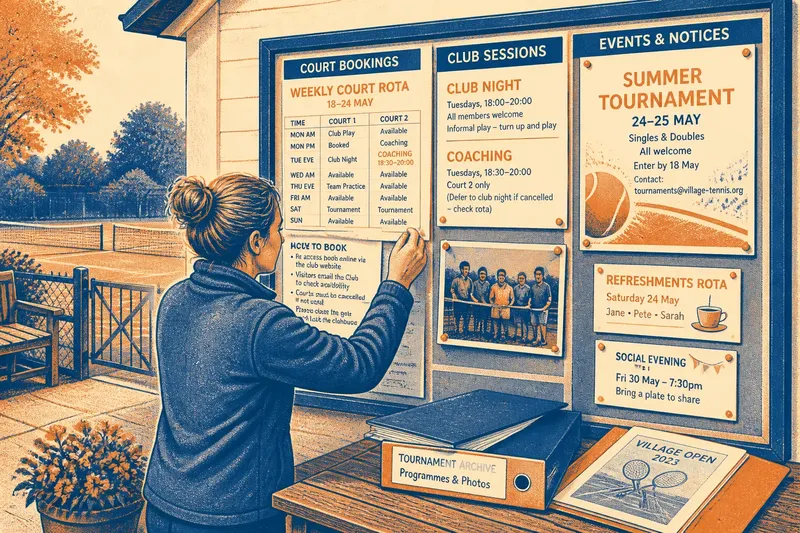
Where can you check tonight’s court rota before leaving home? A village tennis club noticeboard should make that answer easy to find, alongside the booking rules, session times, and the right contact for an access question. In a clubhouse shared by players, visitors, and volunteers, clear information helps a match begin without a search through old flyers.
The board is most useful when it reflects the rhythms of court life: weather-related changes, coaching sessions, club nights, and local tournaments. Keep current playing information prominent, and give past programs or photographs a separate place so they remain part of the club’s story without competing with today’s arrangements.
Put current court arrangements where players look first
Reserve the most visible area for details that affect a player’s next decision: how to book a court, which sessions are open to members or visitors, and whom to contact if the clubhouse or courts are unavailable. Use plain headings such as “Court bookings,” “Club sessions,” and “Access.” A player arriving from a nearby lane should not have to read an event poster to find the booking contact.
Time-sensitive notices need a clear date or period of validity. When a rota changes, replace the old sheet rather than pinning the new one beside it. Carry forward any useful contact details, and identify the court or session affected so that a change to coaching does not look like a change to every booking.
Keep the details that shape the next visit in the easiest-to-scan position.
Separate play information from village club announcements
A tennis board often serves more than one audience. A regular player may be looking for a court slot; a newcomer may want to know whether the Thursday club session welcomes visitors; a volunteer may be checking the tea rota after a match. Group these needs under visible headings rather than letting every new notice claim the same space.
Keep event flyers, refreshments, and social announcements together in a secondary area. If the board is small, rotate those items as dates approach instead of squeezing them around essential court information. For an event notice, name the activity, date, venue, and contact route; for a playing notice, state the action a player needs to take.
Say a village club changes its Tuesday evening coaching slot, and the revised time affects only one court. The volunteer preparing the notice replaces the old rota, labels the affected court and session, and leaves the general booking instructions untouched. A player checking the board can then distinguish the coaching change from the rest of the evening’s court arrangements.
Replace confusing amendments before they spread
A small correction in the margin can be hard to see beside a date crossed out in pen or a second slip taped over the first. This is especially confusing for a visitor who does not know which paper color or handwriting belongs to the latest update.
Replace a notice when its main instruction changes, such as a court assignment, start time, or booking contact. A minor clarification can stay on the original only if it is legible, dated, and does not contradict another displayed notice. Ask one volunteer, or a rotating pair, to check the board after schedule changes and remove superseded copies.
If a player has to compare two versions to work out which applies, post one clean version.
Keep tournament memories without crowding the playing board
Village tournaments leave behind more than a schedule: a program may show the format, a photograph may capture the court-side gathering, and a results sheet may help members remember a particular season. Those pieces can matter to the club, but an active noticeboard is not a comfortable archive. Older material belongs in a labeled binder, a clubhouse folder, or a club-managed digital collection.
Choose items with a clear connection to local play, such as a tournament program, a court-opening notice, or a photograph marked with its occasion. File the date and event name with each item so future members can understand it. Routine notices with no continuing use can be recycled; before keeping or sharing a sheet with personal contact details, consider who should have access to it.
Preserve a few meaningful records, not every sheet that has come off the pins.
Check that the board works for a player arriving today
A quick review can follow the route a player takes from the clubhouse door to the court. Check each item below and act on the result:
- Look for a current court booking rota. If its dates are clear and no older rota remains beside it, leave it in place; if dates overlap or are missing, replace it with one dated version.
- Check the court-use instructions. If the booking method and any court-specific limits are plain, keep the notice; if players must infer them, rewrite the heading and instructions.
- Find the next club session time. If the session, audience, and date are clear, leave the notice visible; if one is missing, add it or remove the notice until it can be corrected.
- Check the access contact route. If a player can identify whom to contact or where to send a message, retain it; if the detail is outdated or unclear, confirm it with the club volunteer responsible for access and replace it.
- Compare schedule changes across the board. If every notice agrees, keep the arrangement; if a coaching or court change conflicts with another sheet, remove the superseded copy and post a corrected version.
- Look for upcoming tournament or social notices. If an event is current and has a clear date and contact, keep it in the events area; if it has passed, move a useful program to the archive or recycle the routine flyer.
- Check whether text is readable from where players stop. If headings and dates can be scanned without leaning close, keep the layout; if not, shorten the wording, enlarge the lettering, or give the notice a less crowded position.
Imagine a club volunteer reviewing the board before a Saturday tournament. The starting materials are a current court rota, an old coaching sheet with a different time, a tournament flyer for the coming weekend, and a program from a past village event. The volunteer checks the dates, confirms that the rota gives the current booking route, removes the conflicting coaching sheet, leaves the upcoming flyer in the events area, and files the older program in a labeled tournament binder. The resulting board shows players where to book and what is happening this weekend, while the past event remains available without obscuring current court details.
What should a village tennis club noticeboard answer?
What belongs on a village tennis club noticeboard?
Show current court-use instructions, booking details, session times, an access contact route, and notices for upcoming club activities. Put older tournament records somewhere separate from instructions players need today.
When should a court rota be replaced?
Replace it when its dates or assignments no longer apply, and remove the superseded copy at the same time. If only one court or session changes, name that scope clearly on the new notice.
Where should old tournament programs go?
File selected programs in a labeled clubhouse binder, folder, or club-managed digital collection. Add the event name and date so a future member can tell what the record describes.
How can a newcomer find the right court information?
Use direct section headings and place bookings, sessions, and access details where they are easy to scan. If a newcomer needs to compare several notices, simplify the board and remove conflicting copies.
Let the board support play and the archive preserve club life
A village tennis club’s noticeboard has a practical job: helping players choose a court, find a session, and respond to changes. A separate archive can hold the programs, photographs, and notices that give local tennis its continuity. Keeping those roles distinct makes the current information easier to use and the older material easier to value.
For a final check, stand where a visitor would stop and look for the current court rota, the next relevant session, and an access contact. If each is easy to identify, the village tennis club noticeboard is serving its daily purpose; if not, move or rewrite the notices before the next match begins.