Why Village Tennis Courts Often Sit at the Edge of the Green
Why village tennis courts sit at the edge of the green: see how shared land, access routes, and nearby facilities shape a practical place for play.
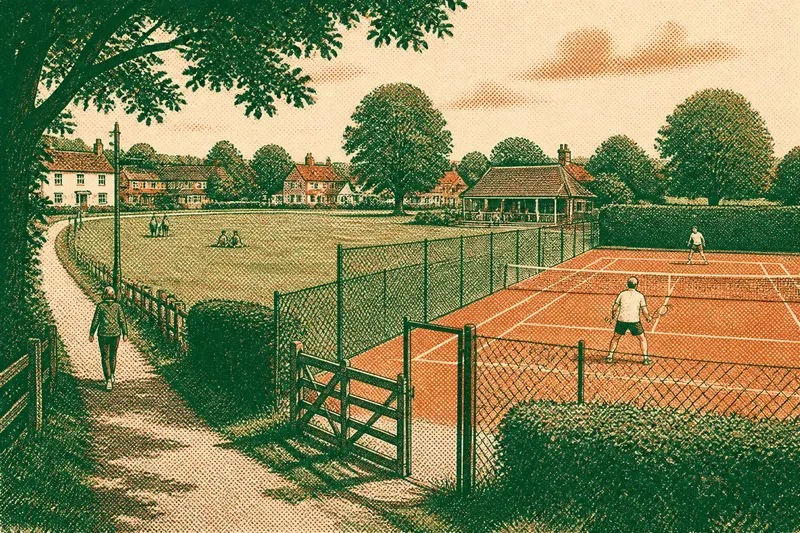
Why do village tennis courts often sit at the edge of the green? The position can leave the center open for shared village use while placing tennis beside paths, buildings, or other facilities. It also lets a court connect with everyday routes without making the playing area part of a public thoroughfare. The reasons differ from place to place, but the pattern often reflects a practical balance between access, space, and separation.
Village tennis courts at the edge of the green balance shared space and play
A village green may serve walkers, informal gatherings, and other activities that do not need a fenced playing area. Placing a court alongside it can preserve a broad open center while giving tennis a defined boundary. The court remains close to the green, but its fence marks a space where play can continue without people accidentally crossing the playing area.
The edge can also make use of land that is less suited to an uninterrupted open lawn: a strip beside a lane, a boundary hedge, or ground near existing buildings. That does not mean every court was deliberately placed there for the same reason. A site may reflect available land, earlier boundaries, later changes, or several practical needs at once.
Think of the edge as a useful meeting point: close enough for connection, distinct enough for different activities.
Access routes often make an edge location convenient
Footpaths and lanes can link the court to the village without sending players across the busiest part of the green. A gate beside an established route is easy to identify, while a fence can keep walkers outside the playing enclosure. This arrangement can serve both players arriving for a match and people using the green for other purposes.
To understand a particular layout, trace the route from a public entrance to the court gate. Note whether the path runs along the fence, approaches from a lane, or passes a clubhouse. A worn track alone does not prove that a route is official or was created for tennis; signs, gates, and a continuous surfaced path offer clearer clues.
Follow the marked route rather than assuming every shortcut is intended for public use.
Boundaries help separate active play from shared ground
A tennis fence, hedge, or tree line can help define where play happens and protect players from passing foot traffic. The boundary may also preserve a clear view across the green, depending on its height and placement. A low or open edge can make the court feel visually connected to village life; a denser screen can give players more privacy and reduce distractions.
These choices involve tradeoffs. A more open boundary may make the court easier to spot but expose play to passing activity. A hedge may soften the view and mark a transition, yet make the gate harder to find. Look at the gate, the sightline from nearby paths, and the space around the fence to see how the site manages that balance.
Nearby facilities can make the court easier to use
Clubhouses, equipment stores, toilets, and seating often work best when players can reach them without a long or confusing detour. An edge location may place a court beside existing buildings or connect it to a shared path. Where facilities sit farther away, the court can still function as part of the same site if routes are clear and accessible.
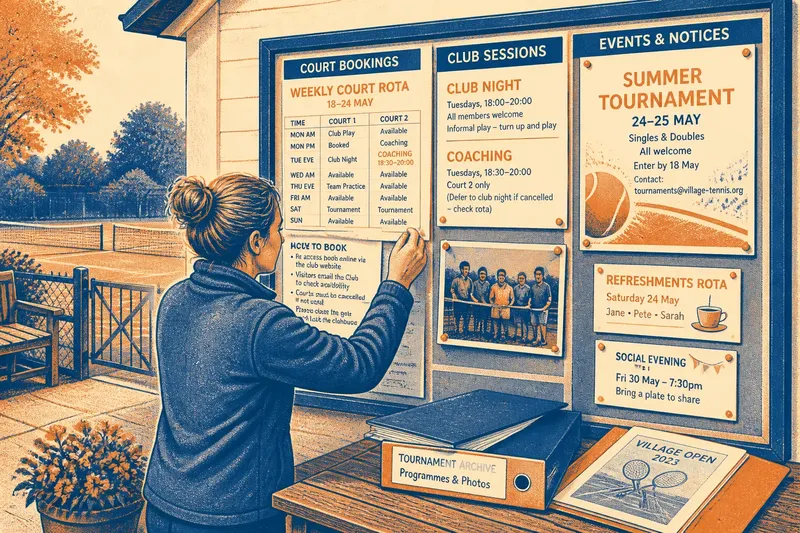
Notice whether players move directly from a clubhouse to the gate or use a path shared with other visitors. A bench facing the court can give companions a place to wait; a notice case beside the entrance can make club information visible without occupying the green itself. These details help explain how the court works within its setting, even when they do not reveal why it was first built there.
What can the court’s position tell you?
Does every village tennis court sit beside a green?
No. Some courts are near a common or recreation field, while others sit beside a school, village hall, or separate club building. The surrounding land and available routes shape each site.
Why might a court be placed near a footpath?
A nearby path can give players a direct approach and connect the court with village routes. Its presence does not establish whether the path was made for tennis or served the area beforehand.
What should I look at around the court fence?
Check the gates, path connections, sightlines, and space between the fence and the green. These features show how the site handles access, visibility, and separation.
Can the court’s position establish who owns the green?
No. A court’s location and visible boundaries do not reliably establish ownership or public access. Signs and local records are more useful; ask the relevant local authority or land manager if the distinction matters.
A site sketch can show how the arrangement works
Imagine you arrive at a village green and want to explain why its court occupies the outer edge. Your starting observations are a public path entering beside a lane, a fenced court with one visible gate, a hedge along the far boundary, and a clubhouse across a short shared path. Sketch the green and court, then add the path, gate, hedge, and clubhouse. Trace the approach from the lane to the gate and mark the shared path to the clubhouse. Your sketch shows that players can reach the court from an existing route, the fence separates play from the green, and the clubhouse is connected but not attached. It supports a practical explanation: the edge keeps tennis distinct while linking it to village access and facilities. It does not establish the original planning decision or ownership.
Use this observation list to decide what your sketch can support:
- Check where the public path begins; if it leads directly to the gate, note a clear approach, but if it ends elsewhere, trace another route before describing access.
- Check whether the gate opens onto a shared path; if it does, describe the connection, but if it opens onto grass, avoid calling that grass an official route without signs or other confirmation.
- Check whether a fence separates the court from the green; if it does, note a defined playing boundary, but if the edge is open, record that separation is less distinct.
- Check what blocks the view from the path; if a hedge or trees screen the court, note reduced visibility, but if the court is exposed, note its open relationship with the green.
- Check the route to the clubhouse or equipment store; if it is direct, record a convenient connection, but if it crosses a public path or detours, note the separation.
- Check for signs at entrances; if they identify the court or public route, use that wording in your description, but if they are absent, describe only what is visible.
- Check for benches or waiting space near the gate; if they sit clear of the entrance, note a place to pause, but if they narrow the approach, record the potential obstruction without assuming how people use it.
Why village tennis courts sit at the edge of the green becomes clearer on foot
The edge often offers a workable compromise: tennis has a defined space, the green retains room for shared uses, and paths or facilities can remain within easy reach. But a court’s present layout is evidence of how the site functions now, not a complete account of how it came to be there.
When explaining why village tennis courts sit at the edge of the green, connect the position to visible features: the gate, the paths, the boundary, and nearby facilities. If you need the historical reason or the legal status of the land, check local records or ask the relevant land manager rather than treating the layout as proof.