How Village Tennis Clubs Choose Between Grass and Hard Courts
Compare grass and hard courts by upkeep, access, and playing feel to decide which surface best fits your village club’s routines and volunteer capacity.
How should a village tennis club choose between grass and hard courts? Start with the club’s actual playing habits and its capacity for care, not an assumed story about how local tennis has changed. Grass and hard courts ask for different routines, and each can shape who feels welcome to play.
Grass courts make maintenance part of club life
A grass court changes with weather and wear. Members need to consider the condition of the turf before play and follow the club’s care routine so busy areas have a chance to recover. That work can make groundskeeping a shared part of club life, rather than a task kept out of sight.
The seasonal character may suit a club whose members enjoy caring for the grounds and gathering around a lawn court. But a surface admired for its appearance can be a poor fit if few people can maintain it or if local conditions often interrupt play. Ask members whether they want to share the work, not only whether they like the look.
Choose grass when members value its particular playing feel and are willing to support the care it requires.
Hard courts support a different routine
A hard court generally requires less lawn care and can make routine use easier to plan, though weather and surface condition still affect play. Its firmer, more consistent response may appeal to players who want a familiar bounce for practice. Some players may find the surface uncomfortable, so their experience matters too.
A hard court does not make a club less rooted in village life. Local character can come from shared habits: lending rackets, welcoming newcomers, arranging informal games, and keeping bookings understandable. The surface is one part of the setting, not a measure of community spirit.
Choose a hard court when regular access and simpler groundskeeping suit the club better than a grass-centered routine.
A mixed setup needs a clear purpose for each court
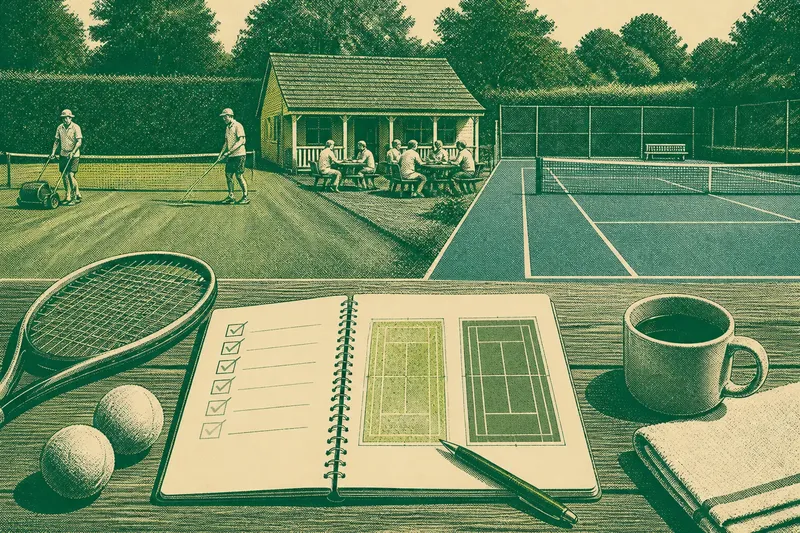
Keeping both surfaces can offer members more than one kind of play, but it also means maintaining and explaining two distinct courts. A mixed setup makes sense only when volunteers and the club’s resources can support each surface without leaving either neglected. Give each court a clear role, such as seasonal grass play and routine practice on a hard court.
Say a village club has one grass court and one hard court, with volunteers available to care for the lawn during its playable season. Members report that they value the lawn for social matches but need a dependable place for evening practice. The club assigns those roles, records the grass court’s condition before opening it for play, and keeps routine practice on the hard court. The expected observable result is a clearer booking pattern, with members choosing a court by purpose rather than treating the surfaces as interchangeable.
Which surface fits your village club?
Who will care for a grass court?
List the members willing to follow the club’s lawn-care routine and check the court before play. If that support is dependable, grass may fit; if not, favor a surface that asks less of the available volunteers.
When do members want to play?
Ask whether members mainly want seasonal gatherings or regular games across changing conditions. If regular access is the priority, favor the court that best supports it locally; if members value a seasonal ritual, grass may be worth its additional care.
How do members describe the playing feel?
Ask players what they notice about bounce and comfort on the surfaces available to them. If the grass court’s feel is a shared preference, include it in the decision; if players prefer the firmer response of a hard court, give that preference weight.
Can volunteers support two surfaces?
Identify who will care for each court and what routine each requires. If both roles have willing owners, a mixed setup may work; if one court would be neglected, concentrate effort on the surface the club can sustain.
Use a simple decision list before committing
Write down what members want, what the club can maintain, and what each surface would be used for. For every observation, agree on what decision follows and what alternative the club would choose if the condition is not met.
- Check whether named volunteers will take part in grass care; if they will, consider keeping grass, and if they will not, favor a lower-maintenance surface.
- Check whether members seek regular play across changing conditions; if they do, prioritize the locally dependable option, and if they do not, consider a more seasonal routine.
- Check whether players prefer the feel of grass; if they do, retain it if care is feasible, and if they do not, give greater weight to another surface.
- Check whether players prefer the firmer response of a hard court; if they do, make it the main practice option, and if they do not, compare the available surfaces before deciding.
- Check whether each proposed court has a distinct role; if it does, explain that role in bookings, and if it does not, simplify the plan to avoid competing uses.
- Check whether volunteers can take responsibility for every surface; if they can, consider a mixed setup, and if they cannot, support one court well instead.
For village tennis club surface choices, the useful question is not which court best represents tradition. It is which arrangement members will play on, care for, and understand as part of their shared routine.