Round Robin or One Long Set? Choosing a Shape for Friendly Play
Round robin or one long set? Choose a friendly tennis format that balances changing partners, fair waiting turns, and an easy finish for your group.

Should your village tennis gathering use a round robin or one long set? For friendly tennis, the choice depends on whether players want changing partners and short turns or the continuity of one match. A little planning before anyone arrives can make either format feel relaxed rather than improvised.
The useful distinction is not which format is more serious. It is how each shares court time, accommodates late arrivals, and gives the group a natural point to stop. Treat the plan as a loose sequence for the morning, with room to adjust when the number of players changes.
A round robin or one long set suits different gatherings
A round robin rotates players through a series of short games or matches. People can change partners and opponents, and a simple rotation helps distribute court time. It works especially well when the group is large enough that one match would leave several people waiting.
One long set keeps a pair or group on court for a continuous contest. Players who enjoy building rhythm may prefer it, and uninterrupted play can feel companionable. The trade-off is that anyone outside the match waits until it ends, so this format is easiest with a small group or a clear plan for turns.
Decide what the gathering is for: mixing the group, enjoying a sustained match, or making room for both. That answer will usually point toward a format.
Set the plan during the week and confirm it on the day
A loose plan made before the gathering prevents one question from taking over at the gate: who plays next? During the week, ask who expects to come and whether anyone needs a shorter or gentler session. A message to regulars or a note at the clubhouse can provide a working headcount.
On the morning, confirm who has arrived before choosing the rotation. A round robin can absorb a changing group more easily than a fixed doubles match, but it still needs someone to keep track of whose turn it is. For a long set, agree on how the next match will begin if more players arrive or someone has to leave.
Say six players are expected, but one may arrive late. The organizer starts with rotating short games, writes the next pairing on a clubhouse whiteboard, then checks in with the late arrival before setting the next round. The expected result is a clear turn for the newcomer without interrupting a pair halfway through a long set.
Give waiting turns a visible rhythm
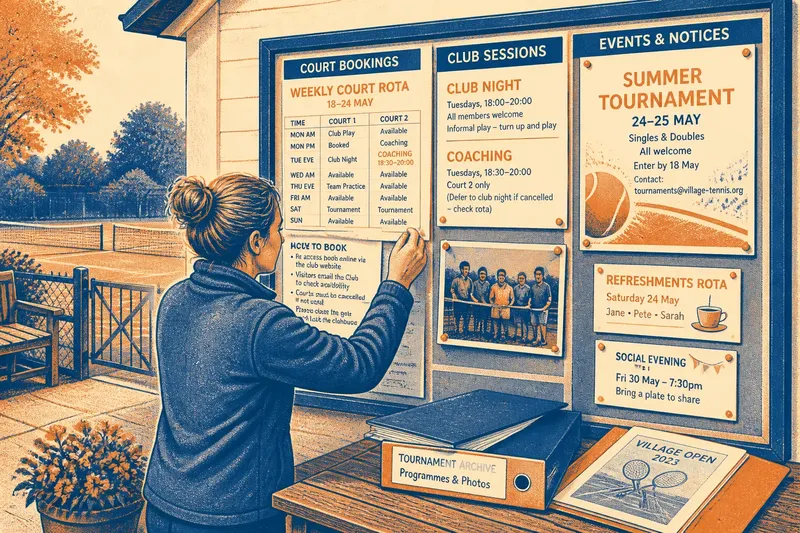
Waiting feels fairer when players know what they are waiting for. In a round robin, write names on a scrap of paper or use a small whiteboard to show the next pairing. Keep the order simple and rotate partners deliberately, rather than asking the same confident players to choose teams each time.
With one long set, make the waiting turn explicit before play begins. Name the next pair, or agree that the next match starts when the set reaches its endpoint. The group may prefer a time cue or a game-based endpoint; choose one players can remember without repeatedly checking a phone.
For either format, leave space for a brief warm-up and a drink between turns. The aim is to keep the day moving without making the court feel like a queue.
Use the morning as a sequence, not a timetable
At arrival, welcome everyone and settle the format while people lace their shoes and find water. Start with a short warm-up that lets players hit with someone beyond their usual partner. If the headcount is still uncertain, begin with a flexible round robin rather than assigning a long match that might need rearranging.
Once play is underway, pause after a natural game or rotation to check whether the plan still fits. A player may need to leave early, or the group may discover that everyone wants another turn. Adjust the next pairing at that pause, not in the middle of a rally or set.
As the gathering approaches its finish, avoid starting a contest that the group cannot comfortably complete. In a round robin, let the current short game be the last one and tell the waiting players. In a long set, agree on a stopping point that feels fair to both sides before the match begins; do not spring a new endpoint on a close contest.
Which format fits your village tennis gathering?
How many players make a round robin useful?
It is most useful when enough people are present that a single match would create a noticeable wait. The organizer can adjust the rotation to the group rather than holding everyone to a fixed bracket.
Can a round robin work with changing partners?
Yes. Changing partners is one of its strengths, and a written pairing order helps share those changes evenly. It also makes it easier for a newcomer to see where to join.
When is one long set the better choice?
Choose it when the group is small and the players want an uninterrupted contest. It also suits a gathering where everyone is content to watch between turns, provided the next players are agreed in advance.
How should a casual session end?
Choose the last game or match before it begins, then give the group a friendly reminder as that point approaches. This avoids a sudden stop or an awkward debate over whether to continue.
Leave room for an easy finish
A friendly session does not need a winner’s table or a formal closing ritual. After the final game, return balls to the basket, let players cool down at their own pace, and ask anyone who has been waiting whether the format worked for them. That small conversation can help shape the next gathering without turning a pleasant morning into a committee meeting.
If the group is unsure which format to choose, start with a round robin and reserve the last stretch for one optional longer match. The rotation gives people a chance to mix, while the final set offers continuity for anyone who wants it. A round robin or one long set can both suit friendly tennis when players know how turns will work and when play will end.